
Category: Underclassmen

  • No AP Classes Freshman Year: What to Do in 9th Grade Instead

    No AP Classes Freshman Year: What to Do in 9th Grade Instead

    Key Takeaways:

    • A school that doesn’t offer AP until junior year isn’t a disadvantage in admissions. Colleges evaluate your student’s transcript against what their high school actually offered.
    • Your counselor reports the school’s course offerings and any enrollment caps directly to colleges, so that context travels with the transcript automatically.
    • The decision that matters in 9th grade is track placement. Honors placement and course sequencing determine which AP courses are even reachable in 11th and 12th grade.
    • Honors courses and dual enrollment carry real weight in 9th and 10th. Both count toward the rigor rating your counselor submits.
    • Four to eight AP courses is a normal total when access opens junior year, and colleges read that number as normal.

    No AP classes freshman year is the standard setup at a large share of American high schools. Your student is a freshman, the course catalog has no AP courses in it, and you’ve read that selective colleges want the most rigorous schedule available. Those two facts feel like they’re in conflict.

    They aren’t. Admissions offices know most schools don’t open AP to freshmen. What they evaluate is whether your student took the hardest path their own school made available to them. That path exists in 9th grade. It just has different names on it.

    Below is what colleges actually see, the scheduling decision this spring that sets your student’s AP ceiling two years out, and what to do with the hours AP courses would have taken.

    Do Colleges Care If You Have No AP Classes Freshman Year?

    No. Course rigor is judged relative to what your high school offers, and a freshman who wasn’t permitted to take AP hasn’t failed to take it. A student at a school with four AP courses can earn the same rigor rating as a student at a school with thirty.

    The reason this works is mechanical, and it’s worth understanding because it takes the pressure off.

    When your student applies, their counselor submits a School Report alongside the transcript. That form includes a curriculum section where the counselor rates the student’s course selection on a scale running from less demanding to most demanding. Counselors also have the option to attach a school profile, which lists the school’s full course offerings, its grading system, and how grades distribute across the student body.

    The form goes one step further. It asks the counselor to state the maximum number of advanced courses a student is allowed to take if school policy limits it.

    So the constraint your student is working inside gets documented by the school itself, in the same envelope as the transcript. You don’t have to explain it in an essay. You don’t have to explain it in the additional information section. It arrives already explained.

    What “Most Rigorous” Means When Your School Doesn’t Offer AP Until Junior Year

    It means the hardest available version of each core subject, in the grade your student is currently in.

    For most freshmen, that’s honors English, accelerated or honors math, honors science, and a world language continued past whatever the graduation minimum requires. If your school has no honors tier in 9th grade either, then the standard sequence is the most rigorous load, and your student is already carrying it.

    Two things genuinely move the rigor rating in 9th grade, and neither one involves AP.

    The first is subject breadth. A freshman taking a core course in all five academic areas, meaning English, math, science, social studies, and world language, reads stronger than one taking four cores plus a study hall. That’s a scheduling choice, and it’s available to everyone.

    The second is staying in the accelerated lane once your student is in it. A transcript that shows honors English in 9th grade and standard English in 10th records that step down, and your counselor’s rigor rating accounts for it. Getting into the honors track happens once. Staying in it is a choice your student makes again at every registration.

    Classroom whiteboard with partially erased math work, shot from an angle

    The 9th Grade Decision That Sets the Junior Year AP Ceiling

    Here’s the part that rarely comes up at freshman orientation. AP courses have prerequisites, and those prerequisites start in 9th grade.

    How the Math Sequence Locks In

    A student placed in Algebra I as a freshman moves through Geometry, Algebra II, and Precalculus, then graduates without reaching calculus. Getting to AP Calculus as a senior generally means starting with Geometry in 9th, or doubling up somewhere in the middle. That placement decision usually happens in the spring of 8th grade, made by a counselor carrying several hundred students who has no particular knowledge of what your student wants to study.

    Science and world language work the same way. So the useful question this spring isn’t which AP courses your student will take. It’s which ones they’ll still be eligible for.

    Subject9th grade placementWhat’s reachable by senior yearWhat closes off
    MathAlgebra IPrecalculus as a seniorAP Calculus, unless your student doubles up in 10th or 11th
    MathGeometry or higherAP Calculus AB or BCVery little, this is the open path
    ScienceStandard BiologyOne AP science, usually as a seniorFitting both AP Chemistry and AP Physics before applications go out
    ScienceHonors Biology or Honors ChemistryTwo AP sciences across 11th and 12thLess
    World languageLevel 1Level 4 as a seniorThe AP language exam, and a second language entirely
    World languageLevel 2, with middle school creditAP language as a junior, plus room for a second languageLess
    English and social studiesStandard, no honorsHonors as a junior at most schoolsAP as a junior, where honors is a stated prerequisite
    Every high school sequences courses its own way. Confirm the actual prerequisite chain with your student’s counselor before registration.

    Why the Honors Track Is the Real Gate

    The bottom rows are the ones parents miss. At a school where AP opens in 11th grade, the honors track in 9th and 10th is frequently the formal prerequisite. A freshman placed in standard English can find in two years that AP Literature was never available to them, not because of AP access, but because of a gate they walked past in 9th grade.

    None of this disqualifies anyone. A student who took the most demanding math their school offered is in fine shape without calculus. The point is that the ceiling gets set early, and a family who understands that gets to choose it deliberately. Our free four-year admissions road map lays out which of these decisions come due in which grade.

    What Counts as Rigor in 9th and 10th Grade When AP Isn’t an Option

    Several things do, and they aren’t equally worth your time or money.

    OptionWhat it isHow colleges read itWhen it’s worth it
    Honors or accelerated trackYour school’s advanced tier below APCounts fully toward the rigor rating, and often gates AP eligibility laterAlways, in every subject where your student can hold a strong grade
    Dual enrollmentA community college course for high school and college creditReal college coursework, read as strong rigor and genuine initiativeSophomore year and later, in a subject your student is already strong in. Eligibility by grade level varies by state and district
    Online AP courseAn AP course through a provider outside your schoolLegitimate, though it won’t appear on the school transcript unless your district accepts the creditOnly when a specific subject central to your student’s interests is missing entirely
    Self-studying an AP examTaking the exam without the courseA score, with no course on the transcript and no teacher relationship behind itRarely in 9th grade. The logistics and the isolation usually cost more than the score returns
    Summer college or pre-college programA course on a college campus or online over the summerVaries widely. Graded credit-bearing courses carry weight, enrichment programs carry much lessWhen the course is graded and in a subject your student intends to pursue
    Dual enrollment eligibility, cost, and transcript treatment are set by your state and district. Confirm all three before enrolling.

    The honest ranking is short. Honors placement first, because it’s free, it’s on the school transcript, and it protects AP eligibility later. Dual enrollment second, starting sophomore year. Everything else is situational.

    Questions to Ask Your Counselor Before Spring Registration

    Registration for next year usually opens in February or March. These six questions take one meeting and resolve most of the uncertainty.

    1. Which 9th and 10th grade courses are formal prerequisites for the AP courses offered in 11th and 12th? Ask for it in writing if you can. This is the single most useful answer on the list.
    2. Does our school cap how many AP or honors courses a student can take in a year? If yes, that cap gets reported to colleges, which means it protects your student rather than penalizing them.
    3. What does our school profile say about course offerings? Ask to see it. Some school profiles are thorough, and some are one stale page.
    4. Is my student in the accelerated math and science sequence, and what would it take to move up? Placement gets made once and then carries forward by default.
    5. Is dual enrollment available, starting in which grade, and does it appear on the high school transcript? The transcript answer matters as much as the eligibility answer.
    6. How many AP courses does a typical strong student here graduate with? This is the number your student will be compared against, and it’s usually lower than parents expect.

    School counselors are the right people to ask all six. They’re also frequently carrying caseloads above 300 students, which leaves little room for a four-year strategic conversation on top of the logistics. If you want that longer conversation, sequencing in 9th grade is one of the highest-leverage places to have it, and it’s a core part of what we do at INSPIRATE Consulting.

    How Many AP Classes Will Your Student Actually Have?

    Somewhere between four and eight, and that’s a normal transcript.

    Do the arithmetic. If AP opens in 11th grade and your student takes two or three AP courses as a junior and three or four as a senior, they graduate with five to seven. At a school that offers eight AP courses total, taking six of them is a most demanding schedule by any reasonable counselor’s standard.

    Compare that to a student at a school offering twenty-five AP courses who takes twelve. The second number is larger. The rigor rating can easily be identical, because both students are being measured against their own school’s menu.

    What actually separates applicants at that point is grades in those courses and what the student did outside them. A student carrying six AP courses with strong grades reads better than one carrying nine at a B minus average. If your student’s grades have already slipped, a sophomore year GPA that needs repair is a fixable problem, and fixing it matters more than adding a seventh AP.

    Three bikes leaning against a bike rack next to a brick building at dusk

    What to Do With the Hours AP Classes Would Have Taken

    This is the genuine advantage of the setup, and most families never spend it.

    A junior taking four AP courses has very little discretionary time. Your freshman has two years of it. The students who use that window well tend to arrive at junior year with something specific already built, which is exactly what the activities section rewards and exactly what’s hardest to manufacture late.

    What that looks like in practice:

    • Depth in one thing rather than sampling six. Two years of the same activity with increasing responsibility reads as commitment. Two years of trying clubs reads as a list.
    • Something that produces evidence. A portfolio, a competition record, a repaired engine, a tutoring practice with actual students, a research log. Anything with a visible output.
    • Teacher relationships. Junior and senior year teachers write the recommendations, and the students who get strong ones usually built the habit of talking to teachers as freshmen.
    • A real summer. Ninth grade summer is the last one with no test prep, no essays, and no application deadlines competing for it.

    Time is the resource your student has more of than their peers at AP-heavy schools right now. Our guide on what starting college prep in 9th grade actually buys goes deeper on how to use it.

    Cropped hand holding a printed page beside a bulletin board of pinned notices

    What to Do Before Registration Closes

    Pick one thing this month: get the prerequisite chart from your counselor in writing.

    Everything else on this page follows from it. Once you know which 9th and 10th grade courses gate the AP courses your student might want in 11th and 12th grade, next year’s schedule mostly builds itself. Without it, you’re guessing, and the guesses compound for two years before anyone notices.

    If you’d like help reading your student’s specific course catalog and building the sequence backward from where they want to end up, schedule a consultation with INSPIRATE Consulting. Ninth grade is the cheapest time to get this right, because nothing has been foreclosed yet.

    FAQs

    Do colleges care if your school doesn’t offer AP classes?

    No. Colleges assess course rigor against what your high school offers, and your counselor documents those offerings on the School Report that accompanies your transcript. A student who took the most demanding courses available at a school with few AP options can receive the same rigor rating as a student at a school with dozens.

    Can a 9th grader take an AP exam without taking the class?

    Yes, though it takes arranging. College Board permits students to sit for an AP exam without enrolling in the course, but students can’t order exams themselves. An AP coordinator at a school that administers exams has to register your student in an exam-only section and place the order. For May 2027 exams, the national ordering deadline is November 13, 2026, and individual schools set their own earlier internal deadlines. Start with your own school’s coordinator in September or October.

    Are honors classes enough if my school doesn’t offer AP until junior year?

    Yes. Honors courses count fully toward the rigor rating your counselor submits, and at most schools the honors track is the formal prerequisite for the AP courses that open in 11th grade. Skipping honors in 9th grade is the more common mistake.

    Should my freshman take a community college class instead?

    Usually not as a freshman. Dual enrollment is valuable, and it tends to work better starting sophomore year, once your student has a full year of high school grades behind them and a subject they’re clearly strong in. Eligibility by grade level, cost, and whether the course appears on the high school transcript all vary by state and district, so confirm those three things first.

    How many AP classes should my student take if AP starts junior year?

    Aim for most of what your school offers in the subjects your student is strong in, which typically lands between four and eight total across junior and senior year. Grades in those courses matter more than the count. Six AP courses with A’s reads better than nine with B minuses.


  • How to Recover From Bad Freshman Grades After First Semester

    How to Recover From Bad Freshman Grades After First Semester

    Key Takeaways:

    • Freshman grades count, and they count less than any other year on the transcript. The University of California excludes them from its GPA calculation entirely.
    • A grade drop is a symptom. Find the cause before you buy tutoring or take the phone.
    • The most common cause in ninth grade is zeros from missing work, not failed tests.
    • Second semester is the fix. A visible climb from fall to spring is the most normal thing on a high school transcript.
    • Course selection for tenth grade is the one decision here with a real deadline.

    The report card came home, and it wasn’t what you expected. Maybe it’s one C in a class your student used to be good at. Maybe it’s a slide across every subject. Either way, you’re trying to figure out whether this is a blip or the start of something.

    Here’s the short version. Freshman grades matter, they matter less than any year that follows, and you still have a full semester to change the shape of the transcript. This article covers how to recover from bad freshman grades: reading what the report card is actually telling you, matching the fix to the cause, and what to do in the next seven days.

    Do Freshman Year Grades Matter for College?

    Yes, but less than any other year on the transcript. Most colleges include ninth grade in the cumulative GPA and weigh it lightly during the read, because admissions readers know what the jump to high school does to fourteen-year-olds.

    Which Colleges Ignore Freshman Grades?

    Some don’t count ninth grade at all. The University of California builds its admissions GPA only from A-G approved courses completed between the summer after ninth grade and the summer after eleventh grade, which means freshman grades are excluded from that calculation completely. You can confirm the current rules on UC’s admissions site.

    One thing families miss: the courses still count even when the grades don’t. If your student took a UC-approved math or world language course in ninth grade, it satisfies part of the A-G subject requirement. The grade just never enters the GPA.

    How Much Does Each Year of High School Count?

    Here’s how each year of high school actually gets used:

    School yearHow admissions reads itWhere it doesn’t count
    9th gradeIncluded in the cumulative GPA at most colleges, weighed lightly in the reviewExcluded from the University of California GPA calculation
    10th gradeIncluded and read more closely, since the transition explanation no longer appliesCounted by UC, with honors weighting capped at 4 points from this year
    11th gradeThe most heavily weighted year, and the last full year most colleges see before decidingCounted by UC
    12th grade fallReported on the mid-year report at colleges that require oneExcluded from the UC GPA calculation
    12th grade springReviewed on the final transcript after admission, and a collapse can cost the offerNot part of any admissions GPA

    Source: University of California Admissions, GPA requirement.

    Can a Bad Freshman GPA Be Repaired?

    It depends on your district. Most high schools average every semester into a permanent cumulative GPA, so a weak fall gets diluted rather than erased. A few allow a retake to replace the original grade. That’s one email to your counselor, and the FAQ at the bottom has the exact questions to ask.

    Why Freshman Grades Drop in the First Semester

    The first semester of ninth grade is the most common place on a high school transcript for grades to fall, and the reason has more to do with how high school works than with your student.

    In middle school, one or two teachers tracked everything and noticed when something was missing. In high school, six teachers each assume your student is tracking it. Grade weight shifts away from daily homework toward tests and long-range projects. Nobody sends a reminder.

    A student who was organized enough for middle school can be under-organized for high school without anything else about them changing.

    The drop is also usually invisible until the report card. The parent portal shows a running average that looks fine in September and doesn’t fall until enough zeros accumulate to pull it down all at once in November.

    Read the Report Card Before You React

    The pattern in the grades tells you more than the grades do. One low grade and six low grades are different problems with different fixes, and the wrong fix costs you the semester.

    Open the grade portal and look at two things: which classes dropped, and whether the drop happened all at once or gradually across the term.

    What the pattern looks likeWhat it usually meansYour first move
    One class dropped, the rest held steadyA content gap or a teacher-fit problem in that single subjectEmail that teacher and ask what specifically cost the points
    Every class dropped by roughly the same amountOrganization, or something happening outside schoolCount missing assignments and look at sleep before anything else
    Grades were fine in September and fell through NovemberMissing work piling up over the termCount the zeros in the portal, class by class
    Test scores are solid but the grade isn’tHomework, participation, and submission pointsFix the submission habit, which takes weeks rather than months
    Homework is complete but test scores are lowA genuine content or test-taking gapThis is the case where paid tutoring earns its money
    Attendance is flaggedAnxiety, avoidance, or a health issueStart with the counselor rather than the teacher

    For a freshman in December, the official transcript won’t tell you much yet. It becomes the document that matters in tenth and eleventh grade, and when you get there, our guide on how to read the official transcript walks through what to check.

    What Caused the Drop, and What Each Cause Needs

    Most freshman grade drops trace back to one of six causes. The fixes aren’t interchangeable, and buying tutoring for an organization problem burns a semester and a few thousand dollars at the same time.

    CauseWhat it looks like at homeWhat actually fixes it
    Transition and workload shockWorking longer hours than in middle school and getting worse resultsA written weekly schedule and one fixed study block. More hours won’t do it
    Zeros from missing workSays the work is done, the portal shows zerosA daily submission check for six weeks, then taper it off
    A content gap from middle schoolReads the chapter, does the problems, still gets them wrongTargeted tutoring on the specific gap, most often in math
    Executive functionLoses papers, starts assignments the night before, forgets long-range projectsExternal structure: one planner, visible deadlines, a weekly reset with you
    Something outside schoolWithdrawn, sleeping much more or much less, quit an activity they used to loveThe counselor first, then your pediatrician. Grades are downstream of this
    Wrong course placementDrowning in one advanced class while holding steady in the othersA level change at the semester break, if the window is still open

    More than one of these can be true at once. If you can’t tell which you’re looking at, the next section sorts it in about ten minutes.

    Executive Function or a Content Gap?

    This is the distinction that decides what you spend money on. A content gap means your student doesn’t understand the material. An executive function problem means they understand it and the points still don’t arrive.

    The test takes one sitting. Pull up graded tests next to the assignment log. If test scores are solid and the grade is low, the material is fine, but the delivery system is broken. If the test scores are the low numbers, there’s a real gap to close.

    Parents default to tutoring because tutoring is purchasable. Executive function support is harder to buy and more effective for the majority of ninth grade cases, which is why the diagnosis has to come first.

    arent and teenage student sitting on a couch having a calm conversation

    What Not to Do in the First Two Weeks

    • Don’t take the phone as your opening move. That’s a consequence. It doesn’t tell you what went wrong, and it usually ends the conversation you need to have.
    • Don’t sign up for tutoring in every subject. You don’t know which subject yet.
    • Don’t say this ruins their college chances. It isn’t true, and it costs you their honesty for the next three years.
    • Don’t call the principal. Start with the teacher.
    • Don’t wait until spring to see if it improves. The window to change second semester courses usually closes within weeks of the report card.

    The Conversation to Have With Your Student

    Open with a question about mechanics. “Walk me through what happened in biology” gets you information. “What happened to you this semester” gets you a shrug.

    Three questions worth asking:

    • Which class felt hardest, and what made it hard?
    • What does turning in an assignment actually look like, from finishing it to seeing it marked as received?
    • Was there a week where everything fell apart at once?

    The last one matters more than parents expect. A single rough week in October can cost a full letter grade if four assignments happened to land in it. That’s a very different problem from a student who doesn’t understand chemistry.

    Should You Email the Teacher or the Counselor?

    Email the teacher when the problem lives inside one class. Email the counselor when it shows up across several, or when the fix is a schedule change.

    Skip “how can my student bring the grade up.” Teachers get that message fifty times a semester and the answer is always office hours. Ask what specifically cost the points, whether it was missing work or assessment scores, and whether there’s any late work policy still available this semester.

    For the counselor, ask three things: when the second semester schedule change window closes, whether the school offers credit recovery for ninth graders, and whether the portal is showing a running average or a final semester grade.

    Should Your Freshman Change Courses for Second Semester?

    Sometimes, and the deadline is usually sooner than you think. If your student is failing or nearly failing one advanced class while holding steady everywhere else, a level change is defensible and often correct.

    What backfires is stripping out all the rigor. Colleges evaluate grades and course difficulty together, and a schedule that gets dramatically easier during a recovery sends a mixed signal.

    The classes with real downstream consequences are math and world language, because both run in chains. Dropping a level in ninth grade math can quietly close off calculus by twelfth grade, which is the kind of thing that only becomes visible three years later. Our guide on which course sequences close early covers how far ahead those decisions reach.

    Make this call with the counselor and the current teacher, rather than alone at the kitchen table.

    Is Tutoring Worth It for a Freshman?

    It’s worth it when the problem is a content gap in a specific subject. It’s mostly wasted when the problem is missing work, because a tutor can’t submit assignments for your student.

    Math is where ninth grade tutoring pays off most reliably. The gaps are concrete, they’re identifiable in about one session, and the material stacks, so closing a gap now prevents three more later.

    Try the free options first. Teacher office hours, the school’s peer tutoring center, and department help sessions before first period exist at most high schools, and most families never ask about them.

    If you’re paying, two sessions a week in one subject beats one session a week across three. Ask for a diagnostic in the first session and a specific list of what’s missing.

    Student writing in a weekly planner beside open textbooks and a laptop

    How to Recover From Bad Freshman Grades in One Semester

    A recovery semester has three phases, and they run in order.

    Weeks one and two. Count the missing assignments in every class, submit whatever the late policy still allows, and confirm the second semester schedule before the change window closes.

    Weeks three through six. One study block at the same time every day. A Sunday review of the grade portal with your student in the room rather than reported to them afterward. A weekly check that submitted work is showing as received.

    The rest of the semester. Taper the checking deliberately. You’re aiming for a student who runs the system without you by the end of the year.

    What you want on the transcript is a spring that’s visibly better than the fall. Admissions readers look at the shape of four years, and ninth grade is the only year where a rough start is close to expected. A climb that starts in the spring of freshman year is the least remarkable thing a transcript can do.

    Will Your Student Have to Explain This on Their Application?

    Almost certainly not. One weak semester in ninth grade followed by three years of steady work needs no explanation, and using the Additional Information section on the Common App to explain it draws attention to something a reader would otherwise have skimmed past.

    The exception is a documented disruption. A serious illness, a death in the family, a mid-year move, or an extended school closure is worth a factual sentence or two. When possible, it should come from the counselor’s letter rather than from your student, because it reads as context instead of as a defense.

    What to Do This Week

    Three things, in this order.

    Open the grade portal and count the missing assignments in each class. If that number is high, you’ve found both the problem and the cheapest fix available.

    Email one person. The teacher if it’s one class, the counselor if it’s several.

    Find out when the second semester schedule change window closes. If it’s inside three weeks, that decision moves ahead of everything else in this article.

    If you want the full four-year picture of what happens when, our free admissions road map lays it out grade by grade.

    Get a Second Read on the Plan

    Most families can handle the diagnosis and the study systems on their own. The harder part to see from inside is what tenth grade should look like once you account for where your student is actually headed. If you’d like that read, book a consultation with INSPIRATE Consulting and we’ll go through the report card, the course options, and the next three years together.

    FAQs

    Can you raise your GPA after a bad freshman year?

    Yes. Ninth grade is the earliest and easiest point to recover from, because you have six semesters left to average against one weak one. The cumulative number moves slowly, so the recovery usually shows up as a trend on the transcript well before it shows up in the average.

    Is one bad semester in freshman year a big deal?

    On its own, no. What matters is what follows it. One weak semester followed by a visible climb reads as a normal high school transition. One weak semester followed by five more reads as a pattern, and that’s the version worth preventing right now.

    Should my freshman drop an honors class second semester?

    It depends on the class and how far behind they are. Dropping a level in a subject where your student is failing is reasonable. Dropping a level in a subject they’re strong in removes evidence of ability, and in math or world language it can also close off higher-level courses in eleventh and twelfth grade.

    Does a bad freshman semester affect class rank?

    At schools that still calculate rank, yes, since rank is usually built from the cumulative GPA. Many high schools have stopped reporting it entirely. Ask your counselor whether yours does before spending time on it.

    Can a freshman retake a class to replace the grade?

    That’s district policy rather than state law, so the answer varies. Ask your counselor three questions: does a retake replace the original grade or average with it, does the original stay visible on the transcript, and is there an enrollment deadline?

    Is summer school worth it after a rough freshman year?

    It can be, for two different reasons: recovering credit in a failed class, or retaking a course for a better grade where district policy allows it. Summer coursework doesn’t read badly to admissions officers. Confirm with your counselor how your district records it before you enroll.

  • A 3.4 GPA Sophomore Year: What a Realistic Catch-Up Sequence Looks Like

    A 3.4 GPA Sophomore Year: What a Realistic Catch-Up Sequence Looks Like

    Key Takeaways

    • A 3.4 GPA sophomore year is recoverable, though the ceiling is lower than most families expect: straight A’s from here lands around a 3.70 at application time.
    • The difference between a perfect junior year and a very good one is about 0.15 points. The difference between a very good junior year and no change at all is what actually decides the outcome.
    • Diagnose before you plan. A 3.4 caused by missing assignments needs a completely different fix than a 3.4 caused by struggling on tests.
    • Junior year course registration happens this spring. It’s the highest-leverage decision left on the calendar.
    • Admissions readers see a transcript as a shape. A 3.7 climbing out of a 3.4 reads differently than a flat 3.7.

    A 3.4 GPA sophomore year is fixable. It’s also lower than most families realize once you do the arithmetic, because three of the semesters colleges will eventually see are already finished and can’t be changed.

    That’s the part nobody says out loud, and it’s where any honest plan has to start.

    This article does the math on what your student’s GPA can realistically become, gives you a way to figure out why the 3.4 happened, and lays out a term-by-term sequence from this spring through senior fall. The goal isn’t reassurance. It’s a plan you can actually run.

    What a 3.4 GPA Sophomore Year Actually Means

    A 3.4 is a B+ average. It keeps state flagships, strong regional privates, and a wide range of very good colleges fully in play. It takes the most selective schools off the table unless something unusual is happening elsewhere in the application.

    That’s the whole picture, and it’s less dramatic than most families fear.

    Here’s what makes sophomore year the right time to catch this. Your student still has two full academic years on the transcript before applications go out. A junior with a 3.4 has one. A senior with a 3.4 has none, and is instead building a college list around the number they already have.

    Admissions readers also don’t average your student into a single digit and stop there. They look at the transcript as a sequence. A student who went 3.2, 3.4, 3.9, 3.9 tells a story. A student who went 3.6, 3.6, 3.5, 3.5 tells a different one, even if the two land at the same average.

    Your student is currently in the only window where they can still author that story.

    Read the Transcript Before You Make a Plan

    Pull the official transcript, not the parent portal snapshot. The number your school reports and the number colleges evaluate are often different, and you can’t plan around a figure you haven’t confirmed.

    Four things to check:

    • Semester grades or year grades. Some high schools put both on the transcript. Some report only the final year grade. If only year grades appear, a strong spring partially absorbs a weak fall inside one line. If both semesters show, the recovery becomes visible term by term, which is better for the trend.
    • Weighted or unweighted. The GPA your school hands out is usually weighted. Many colleges look at the unweighted version. Those two numbers can sit half a point apart.
    • Whether the college will recalculate. A fair number of admissions offices strip out PE, health, and non-academic electives, then rebuild the GPA from core courses only. Depending on where your student’s weak grades sit, that can move the number in either direction.
    • Class rank. Some schools report it, many have stopped. If yours does, that’s a second data point traveling with the transcript, and you should know it.

    If your student is aiming at the University of California system, the calculation is different enough to change the entire picture. UC uses only A-G approved courses taken from the summer after 9th grade through the summer after 11th grade, which means freshman year grades don’t count at all. Honors and AP courses earn an extra point per semester, capped at 8 points total across 10th and 11th grade, with no more than 4 of those coming from sophomore year. Confirm the current rules on UC’s admissions site before you build a plan around them.

    For a California student, a rough freshman year is genuinely erased. That’s worth knowing before you spend the spring worrying about it.

    The Math: How High Can Your Student’s GPA Actually Go?

    If your student earns straight A’s from this semester forward, the cumulative GPA at application time will be roughly 3.70. Not 3.9. Three completed semesters at 3.4 stay on the transcript permanently and get averaged in with everything that follows.

    Here’s what each realistic scenario produces:

    What your student averages from spring sophomore year onCumulative GPA at application (through junior year)Cumulative GPA with senior fall added
    Straight A’s (4.0 per semester)3.703.74
    Mostly A’s with a few B’s (3.7)3.553.57
    An even mix of A’s and B’s (3.5)3.453.46
    No change (3.4)3.403.40

    These figures assume an unweighted 4.0 scale, equal weight per semester, and a GPA counted from 9th grade forward. Your student’s actual school may use weighted grades, credit-hour weighting, or a different starting point, all of which shift the numbers. Pull the transcript and run it with your student’s real grades before treating any of this as precise.

    Two things in that table matter more than the ceiling.

    Senior fall barely moves the number. Going from 3.70 to 3.74 is nothing. Every family that plans to “really turn it on senior year” is planning around a lever that doesn’t exist. The work has to happen now and next year.

    The gap between perfect and very good is small. Straight A’s gets a 3.70. Mostly A’s with a few B’s gets a 3.55. That’s 0.15 points separating a flawless two years from a realistic strong two years, and the two will look nearly identical to an admissions reader.

    The gap that actually matters is the one between 3.55 and 3.40. That’s the difference between a visible climb and a flat line, and it’s reachable without perfection.

    Why the 3.4 Happened

    Before you change anything, figure out what caused it. The fixes are not interchangeable, and a plan built on the wrong diagnosis wastes the one spring you have.

    What you’re seeingLikely causeFirst move
    Most grades are fine, one subject collapsedA skill gap or a bad fit with that courseTargeted help in that one subject, nothing else
    Every class sits in the B to B+ rangeStudy method, not effortChange how your student studies, not how long
    Test scores are solid, the grade is still lowMissing or late assignmentsA submission system and weekly portal checks
    Grades dropped mid-year after a decent startSomething outside school changedA conversation before any tactics
    Real effort, heavy schedule, still B’s and C’sThe course load is too muchReduce rigor in one subject for junior year

    Most students are some combination of two of these. Pick the dominant one and start there.

    How Grades Actually Go Up

    Almost all “raise your GPA” advice stops at working harder. That advice fails because most struggling sophomores are already tired.

    Here’s what actually produces a different transcript.

    Count the Missing Assignments First

    A student turning in 85 percent of assignments in a class where homework is 25 percent of the grade is losing most of a letter grade before a single test. Log into the grade portal together and count the zeros. If there are more than two per class, the problem is a system, and a system is fixable in a week.

    The system doesn’t have to be elaborate. One place where every assignment gets written down, checked at the same time daily, and a Sunday review of the portal to catch anything that slipped through. That’s it.

    Rereading Notes Is Not Studying

    It feels productive because the material looks familiar, and familiarity is not the same as recall. Your student needs to close the notes and write down what they remember, then check. That’s the part that builds durable memory, and it’s uncomfortable, which is exactly why students avoid it.

    Log Every Wrong Answer and Why

    After every quiz and test, your student should write down which questions they missed and why. Careless error, didn’t know it, ran out of time, misread the question. Three tests in, the pattern is obvious. Without that log, students study everything equally and improve slowly.

    Have Your Student Ask the Teacher Directly

    One conversation with a teacher changes more than ten hours of studying. Most sophomores have never asked what specifically they’d need to do to move up a letter grade. The answer is usually concrete, and teachers remember the students who ask.

    Fix One Class Before Fixing Five

    A student trying to raise five grades at once usually raises none. Pick the subject where the gap between current grade and reachable grade is largest, put the effort there for six weeks, then move on. One class going from a C+ to an A moves the semester GPA more than five classes each going up a notch.

    How to Have This Conversation Without a Fight

    Lead with the plan, not the grade. Your student already knows the GPA. Opening with the number tells them nothing new and signals that this is a judgment conversation.

    Most sophomores in this position are somewhere between embarrassed and defensive, and often both. If the conversation starts with disappointment, it ends with a closed door and a plan you’re executing alone.

    A few things that help:

    Ask what’s actually hard before you propose solutions. The answer is frequently different from what you assumed, and students who feel diagnosed correctly participate. Students who feel managed don’t.

    Separate the diagnosis from the consequence. If there’s a conversation to have about phone use or screen time, have it on a different day. Combining the two turns a planning session into a negotiation.

    Give your student one decision that’s genuinely theirs. Which class to focus on first, or which afternoon is the study block. Ownership of something small makes the rest feel less imposed.

    Say the math out loud. Most students assume a 3.4 has ended things. Telling them the realistic ceiling is a 3.70 and that a 3.55 is a genuine climb often does more for motivation than any amount of encouragement.

    Parent and teenage student talking at a kitchen table with school papers

    Choosing Junior Year Courses When Your Student Is Recovering

    This is the highest-leverage decision on the calendar right now, and registration is usually open in February or March.

    The instinct is to drop everything hard to protect the GPA. That instinct is half right. A student who drops to an all-standard schedule will likely post better grades, and colleges will read a transcript where rigor decreased right when it should have increased. Course difficulty and grades are evaluated together, and neither one covers for the other.

    The workable version is selective. Keep or add rigor in the one or two subjects where your student is genuinely strong, because that’s where an A in an honors or AP class is realistic. Step down in the subject that caused the problem. A student who takes AP US History, honors English, and regular chemistry after a rough year in science has made a defensible, readable choice.

    What you’re avoiding is the middle path where your student carries four hard classes at a B minus. That produces a transcript with neither strong grades nor a clear signal about what your student is good at.

    This is the point where families most often benefit from an outside read. Your school counselor is the right person to ask about what’s offered and what the prerequisites are, though with caseloads frequently above 300 students they have limited time for a two-year strategic conversation. If you want that conversation, it’s a core part of what we do at INSPIRATE Consulting, and spring of sophomore year is the right time to have it, because the schedule you set now runs for two years.

    What Grade Repair Is Actually Available

    Grade repair options are set by your district, not by the state or by colleges, so there’s no universal answer here. What you need are the four questions to ask your school counselor:

    1. Does a retake replace the original grade or average with it? This single answer determines whether retaking a class is worth a summer. Some districts replace, some average, some leave both grades visible with only one counting.
    2. What shows on the transcript after a retake? Many transcripts display the original grade with a notation. Colleges will see it either way, which is fine, and you should know in advance.
    3. Is credit recovery available for a D, or only for an F? Districts vary widely, and many restrict recovery to failed courses only.
    4. Will a summer course through a community college or an approved online provider count? If yes, get the specific list of approved providers in writing before enrolling anywhere.

    One thing worth saying plainly: summer school does not look bad. Admissions readers see a student who identified a problem and spent their summer fixing it. That’s a favorable read, not a red flag.

    The Term-by-Term Catch-Up Sequence

    Here’s the full sequence from this spring through senior fall, with one priority per term. One is the point. Students who try to fix six things at once fix none.

    TermThe one priorityDone by the end of it
    Spring, sophomore year (now)Stop the bleeding and lock junior coursesMissing work cleared, junior schedule submitted, official transcript pulled
    Summer after sophomore yearRepair one thing, don’t overloadAny retake or credit recovery finished, one weak skill addressed
    Fall, junior yearProve the trend on a full academic loadOne semester of strong grades on the hardest schedule your student can actually carry
    Spring, junior yearHold the line and take the testSecond strong semester, one official SAT or ACT sitting completed
    Summer after junior yearBuild the list and start the essayRealistic college list drafted, personal statement in progress
    Fall, senior yearApply, and keep senior grades cleanApplications submitted, mid-year report that helps rather than hurts

    Notice that junior year carries the entire weight. Both semesters have to land. That’s the reality of starting from a 3.4 in the spring of sophomore year, and it’s why the course selection decision above matters so much.

    Where Standardized Testing Fits

    Testing gives a recovering student leverage that grades alone can’t. A strong SAT or ACT tells an admissions office that the transcript understates the student, which is exactly the argument a 3.4-to-3.7 applicant is making.

    That effect is larger now than it was a few years ago. Several highly selective institutions have reinstated testing requirements, and at schools that require or strongly consider scores, a strong result carries real weight against a modest GPA.

    What that means for a sophomore this spring: not full test prep. Your student’s grades need the attention right now, and prep that competes with coursework is self-defeating. Take one untimed practice test over the summer to establish a baseline and identify which test suits your student better. Real preparation starts in junior year, and the first official sitting belongs in spring of junior year at the earliest.

    Laptop and handwritten notebook on a desk during college research

    What the College List Looks Like Now

    This is the genuinely good news, and it’s the part most articles skip.

    A 3.7 with a visible upward trend is a profile that certain colleges actively want. Honors colleges at strong public universities are built for exactly this student: someone with real ability whose transcript took a while to show it. Admission to an honors college is often more accessible than the raw selectivity of the university suggests, and the academic experience inside one is frequently better than at a more selective school where your student would be unremarkable.

    Merit aid works the same way. Private colleges working to raise their academic profile give substantial money to students who sit above their median. A 3.7 that’s below the median at one school is comfortably above it at another, and that difference can be worth tens of thousands of dollars over four years.

    There’s also a real argument that a student who spent two years learning how to study is better prepared for college than a classmate who coasted to a 4.0. That’s not a consolation prize. Colleges that read files carefully notice it.

    Calibrating a list around a 3.4 that became a 3.7 takes specific knowledge: which honors colleges have accessible thresholds, which schools weight trend heavily, and where merit money actually goes. That’s a large part of the list-building work we do with families at INSPIRATE Consulting, and it’s usually the difference between a list built on rankings and a list built on where your student will be wanted.

    Senior Year: Whether to Explain the Dip

    Usually, no. A grade pattern that recovered on its own doesn’t need narration, and explaining it draws attention to something the transcript already resolved.

    The exception is when something outside your student’s control caused the dip. Illness, a family crisis, housing instability, or a significant caretaking obligation are all legitimate context, and the Common App has dedicated space for it.

    Two boxes exist. The Additional Information section holds up to 300 words for context that doesn’t fit anywhere else, reduced from 650 words starting with the 2025-2026 cycle. A separate Challenges and Circumstances section allows up to 250 words specifically for hardships that affected academic performance or participation. Verify the current limits on Common App’s site when your student applies, since these have changed recently.

    If your student uses either box, the entry should be factual and short. State what happened, state the effect, and stop. A few sentences reads as judgment. Three hundred words reads as an excuse.

    What Not to Do

    • Don’t drop all rigor to protect the GPA. A safer schedule with better grades and no course difficulty is a weaker application than a mixed schedule with slightly lower grades.
    • Don’t add extracurriculars right now. Sophomore spring is for consolidating what your student already does and going deeper. A new activity added under academic pressure usually costs grades and gains nothing.
    • Don’t hire four tutors. Fix one subject at a time. Simultaneous intervention in every class produces exhaustion and no measurable change.
    • Don’t count on senior year. The math above shows why. Senior fall moves the cumulative GPA by about four hundredths of a point.
    • Don’t compare your student to a classmate’s transcript. Different course loads, different weighting, different starting points. It generates anxiety and produces no information you can act on.

    What to Do This Week

    Three things, in order.

    Pull the official transcript and calculate the unweighted GPA yourself. Then run the four scenarios from the table above with your student’s real numbers, so you’re both working from the same picture.

    Open the grade portal and count the missing assignments in each class. If the count is high, you’ve found the problem and the fix, and it’s the fastest win available.

    Then look at the junior year course registration deadline. If it’s inside the next six weeks, that decision moves to the front of the line.

    Everything else in this article can wait a week. Those three can’t.

    Get a Second Set of Eyes on the Plan

    Most families can handle the diagnosis and the study systems themselves. Where it gets harder is the two-year strategic call: which courses, which tests, and eventually which colleges will read your student’s climb as the asset it is.

    INSPIRATE Consulting works with families on exactly that. Schedule a consultation and we’ll go through the transcript, the junior year schedule, and what a realistic list looks like from here.

    FAQs

    Can a student with a 3.4 GPA get into a good college?

    Yes. A 3.4 keeps state flagships, honors colleges, and a wide range of strong private universities in play, particularly with an upward trend and solid test scores. The most selective institutions become unlikely, and that’s a small slice of the roughly 2,500 four-year colleges in the country.

    How much can a GPA realistically go up in one year?

    For a sophomore with three completed semesters at 3.4, a perfect junior year brings the cumulative to about 3.70. A very strong year brings it to roughly 3.55. Cumulative GPAs move slowly by design, which is why the trend on the transcript often matters more than the final average.

    Do colleges care about freshman year grades?

    Most colleges include freshman grades in the cumulative GPA and weight them lightly in their read, since they know students mature. The University of California system excludes 9th grade from its GPA calculation entirely. Check the policies of the specific schools on your student’s list.

    Should my student drop an AP class to protect their GPA?

    It depends on which class. Dropping the AP in a subject your student struggles with is defensible and often smart. Dropping the AP in a subject they’re strong in removes their best evidence of ability. Course rigor and grades get evaluated together, so a schedule that gets easier during recovery sends a mixed signal.

    Does summer school look bad on a transcript?

    No. Admissions readers see a student who identified a weakness and used their summer on it, which reads as maturity. What matters more is whether your district replaces the original grade or averages it, so confirm that with your counselor before enrolling.

    Is sophomore year too late to turn things around?

    It’s the last year where a full turnaround is possible. Your student has four semesters remaining that colleges will see before applications go out, which is enough to establish a clear trend. A junior starting the same process has two, and the arithmetic gets considerably tighter.

  • When to Start College Prep: What Two Extra Years Actually Buy

    When to Start College Prep: What Two Extra Years Actually Buy

    Key Takeaways:

    • Starting in 9th grade mostly buys optionality. It keeps course sequences, testing calendars, and activity paths open that otherwise get decided by default.
    • Junior year is a reasonable starting point for most families. A strong application is still very much on the table.
    • Math and world language sequences set in 9th grade determine which courses your student can reach by senior year.
    • Essays, college lists, application strategy, and interview prep are all fixable junior year. Four years of transcript and a deep activity record are not.
    • Recruited athletes, arts applicants with portfolios, and students targeting direct-admit programs are the group for whom the early timeline is closest to a requirement.

    If you’ve talked to a college consultant about your ninth grader, you’ve probably been quoted an engagement that runs all four years. And you’ve probably wondered whether the first two years are real work or a longer contract.

    It’s a fair question, and when to start college prep is one of the few admissions decisions that’s genuinely yours to make. Your student is fourteen. Applications don’t open for three years. Almost everything you hear about, essays and test scores and school lists, happens junior and senior year anyway.

    Here’s what the extra two years actually get you, what junior year can still fix, and how to tell which timeline fits your student.

    When to Start College Prep: 9th Grade or Junior Year

    Most students can build a strong application starting in the fall of junior year. Starting in 9th grade widens the set of choices still available when applications open. It doesn’t, on its own, produce a stronger applicant.

    That distinction is the whole article. Early prep buys decisions. Later prep buys execution. Both matter, and they aren’t interchangeable.

    A family that starts in 9th grade is choosing a course sequence, a testing calendar, and a direction for how their student spends three summers. A family that starts junior year is optimizing whatever those choices already produced. Sometimes what they inherit is excellent and there’s nothing to regret. Sometimes there’s a ceiling in place that nobody meant to set.

    What the Extra Two Years Actually Buy

    The honest answer varies by category. Some parts of the application are equally reachable from either starting point. Others close quietly.

    Part of the applicationStarting in 9th gradeStarting junior year
    Math and science course sequenceFully openLimited to what’s already scheduled
    World language sequenceFully openLimited to what’s already scheduled
    Activity depth and leadershipFour-year arc possibleOne to two years of evidence
    Summer planningThree summers availableOne summer available
    Testing calendarSpread across 18 months or moreCompressed into about 12
    College list buildingBuilt and revised over timeBuilt quickly
    Personal statement and supplementsSameSame
    Application strategy and interview prepSameSame
    Reflects typical U.S. high school scheduling. Your student’s school may sequence courses differently, so confirm with their counselor.

    Look at the bottom two rows. The visible, stressful, expensive-feeling part of the application is the part that doesn’t change based on when you start. The parts that do change are the quiet structural ones nobody thinks to ask about at a fall information night.

    The Course and Testing Math

    Two scheduling decisions get made before your student ever thinks about college applications, and both of them determine what’s available senior year: the math sequence and the world language sequence.

    Course sequences get set in 8th and 9th grade

    At most high schools, a student who takes Algebra I in 9th grade moves to Geometry, then Algebra II, then Precalculus, and graduates without calculus. Reaching AP Calculus as a senior usually means starting with Geometry in 9th, or doubling up somewhere in the middle.

    That’s a scheduling constraint, and a counselor carrying several hundred students typically decides it in the spring of 8th grade, with no particular knowledge of what your student wants to study.

    World language works the same way. Selective colleges generally want to see four years of one language. A student who switches languages in 10th grade caps out at three unless they double up. Science ordering determines whether both AP Biology and AP Chemistry fit before applications go out.

    None of this disqualifies anyone. Colleges evaluate course rigor against what your student’s high school actually offered and what was reachable from where they started. A student without calculus who took the most demanding math available to them is in fine shape. The point is that the ceiling gets set early, and a family who understands that gets to choose it deliberately.

    Testing is a scheduling problem first

    Most students sit for the SAT or ACT two or three times. If preparation starts in the spring of junior year, the available dates are junior spring, summer, and fall of senior year. That last sitting lands in the same weeks as applications, supplements, and early deadlines.

    Starting in sophomore spring spreads the same number of attempts across a year and a half with nothing else competing for the calendar.

    There’s also a diagnostic argument. Figuring out early whether your student performs better on the SAT or the ACT saves months of preparation aimed in the wrong direction. And if National Merit is a goal, the qualifying PSAT/NMSQT is the junior fall administration, which means the preparation window for it closes during sophomore year.

    What Each Timeline Looks Like Year by Year

    Here’s the same comparison laid out chronologically, which is usually how parents think about it.

    GradeStarting in 9th gradeStarting junior year
    9thFour-year course plan built; activities chosen with an arc in mindStudent and family making these calls alone
    10thCourse plan adjusted; testing diagnostic; first summer planned deliberatelySame
    11thTesting largely finished by spring; college list forming; essay brainstorming beginsEverything starts at once: testing, list, essays, strategy
    12thApplications executed against a plan built over three yearsApplications executed against a plan built over eight months
    Timelines shift for students applying to programs with auditions, portfolios, or athletic recruitment.
    a planner with two pens sitting on top of it

    What You Can Still Fix Junior Year

    Quite a lot, and this is the part the industry tends to undersell.

    The entire visible application gets built in the eighteen months between junior fall and senior winter. The personal statement and every supplemental essay. The college list, including whether it’s realistically balanced. The decision about whether to apply early decision, early action, or neither, which is one of the highest-leverage strategic calls in the whole process. Which teachers to ask for recommendations and how to give them something useful to write about. Interview preparation. Senior year course selection, which colleges do look at.

    Testing usually has one more full cycle available. Activity framing, meaning how three years of involvement gets described in limited space, is entirely a junior and senior year exercise, and it’s often where the largest single improvement happens.

    If your student arrives at junior fall with solid grades and real involvement in a couple of things, a counselor starting then has plenty to work with.

    What’s Hard to Fix Junior Year

    Three things, mostly.

    The transcript. Your student’s school has already recorded ninth and tenth grade grades. Junior year carries the most weight in most reviews, but a rough freshman year stays on the document. It can be contextualized. It can’t be replaced.

    Depth in activities. Leadership roles typically go to students who’ve been present for a while. A student who joins three clubs in junior fall is visibly a student who joined three clubs in junior fall. Two years of steady involvement in one thing reads differently than two months in five things.

    The course ceiling. Covered above. By junior fall, senior year options are mostly determined by what came before.

    There’s a fourth that gets less attention. Recommendation letters come from teachers who know your student well, and that knowing takes more than one semester. A sophomore who’s been showing up to office hours has a very different letter waiting for them.

    What You Can Do Yourself in 9th and 10th

    You don’t need to hire anyone to capture most of the early advantage. Six things, all free:

    Before spring registration

    1. Get the four-year course plan on paper before spring registration. Sit down with your student’s school counselor and map all four years, including which sequences depend on which. Ask specifically what has to happen in 9th and 10th for the senior year courses to be reachable.
    2. Read the actual admission requirements for two or three colleges your student is curious about. Not a ranking list or a consultant’s summary. The university’s own admissions page.

    Habits that pay off later

    1. Start a running activities document now. Date, role, hours per week, what your student actually did. Three years later this is the difference between an accurate activities list and a guess.
    2. Protect one summer for something unstructured. A job, a hobby taken seriously, time with family. Three consecutive programmed summers is how burnout starts.
    3. Have your student build one real relationship with a teacher. Office hours, questions after class, a genuine interest in the subject.
    4. Don’t buy test prep yet. A sophomore diagnostic is useful. A sophomore prep course is usually early.

    Do those six things and you’ve captured a meaningful share of what a 9th grade engagement provides. What you won’t have is someone catching the specific things you didn’t know to ask about, which is the actual product.

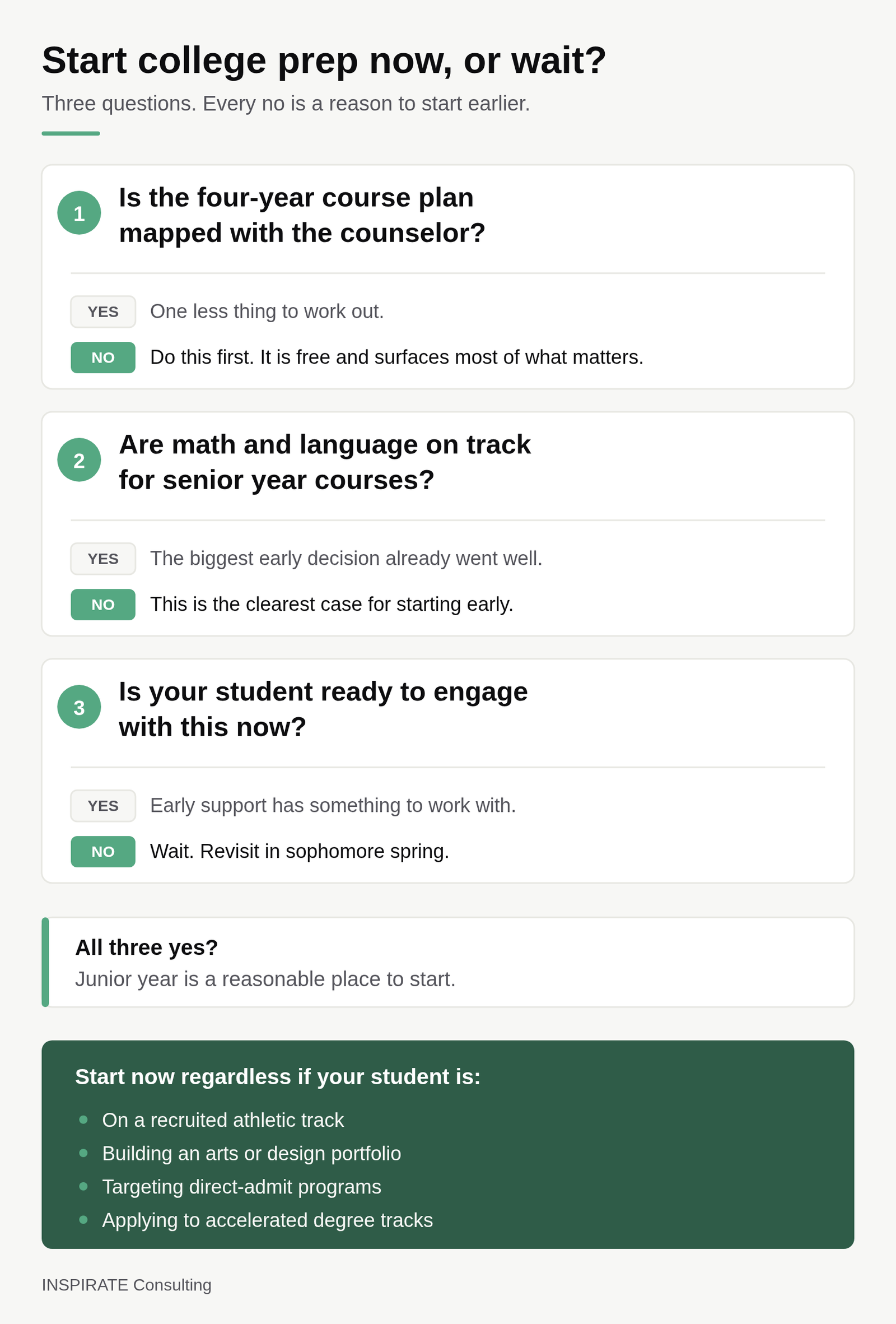
    college-prep-timing-decision

    When Starting Junior Year Is the Right Call

    For a lot of families, and there’s no reason to feel behind about it.

    Start junior year if your student is already in a rigorous course sequence and doing well in it. If the structural decisions went well by default, you’re paying to confirm choices you already made.

    Start junior year if your fourteen-year-old isn’t invested. A student who doesn’t want this yet will treat early meetings as one more obligation, and resistance costs more than the delay does.

    Start junior year if you want your student to have two more years of being a kid. That’s a legitimate priority, and over-professionalizing a freshman carries real costs that don’t show up in any table.

    Start earlier if your student is on a recruited athletic track, building an arts portfolio, or targeting direct-admit or accelerated programs. Those timelines run ahead of the standard one, sometimes by years, and the deadlines are genuinely different.

    The Bottom Line

    The extra two years buy decisions, not outcomes. If the decisions in front of your ninth grader are consequential and unclear, and course sequencing usually qualifies, early support is worth what it costs. If your student’s path is already set and going well, junior year is a perfectly good place to start.

    The one thing worth doing this month regardless: get the four-year course plan on paper and ask the counselor what depends on what. That conversation is free and it surfaces almost everything a family would want to know.

    If you’d like a second read on that plan, INSPIRATE offers a consultation where we’ll look at your student’s current course sequence and tell you honestly whether starting now makes sense for your family. Sometimes the answer is that it doesn’t, and you should hear that before you commit to anything.

    FAQs

    1. When should you start college prep?

    There’s no single right answer. Most students do fine starting in the fall of junior year, when essays, testing, and college lists all become live. Starting in 9th grade is most valuable for families making complicated course sequencing decisions, or for students on recruited athletic, arts portfolio, or direct-admit tracks where the timeline runs earlier.

    2. Is it too late to start college prep junior year?

    No. The majority of the visible application gets built junior and senior year, including every essay, the college list, application strategy, and interview preparation. What’s harder to change by then is the transcript, the depth of the activity record, and which senior year courses are reachable.

    3. What should a 9th grader do to prepare for college?

    Build a four-year course plan with the school counselor, take the most demanding courses they can handle well, get involved in one or two things they actually care about, start a running document tracking activities and hours, and build a real relationship with at least one teacher. Formal test prep can wait.

    4. Does starting college prep early improve admission chances?

    Not by itself. Colleges evaluate the application in front of them, and they have no way of knowing when a family started preparing. Starting early helps by keeping options open that otherwise close, which can produce a stronger application. The mechanism is the course rigor and the depth, not the start date.

    5. Should a 9th grader take the SAT?

    Generally no. A diagnostic in sophomore year is useful for figuring out whether the SAT or ACT is the better fit and where the baseline sits. Official sittings usually make the most sense starting in sophomore spring or junior fall.

    6. What’s the most common mistake families make by starting late?

    Discovering in junior fall that a senior year course they wanted isn’t reachable because of a sequence decision made in 8th grade. It’s rarely fatal to an application, and it’s almost always avoidable with one conversation three years earlier.