


Key Takeaways:
- Starting in 9th grade mostly buys optionality. It keeps course sequences, testing calendars, and activity paths open that otherwise get decided by default.
- Junior year is a reasonable starting point for most families. A strong application is still very much on the table.
- Math and world language sequences set in 9th grade determine which courses your student can reach by senior year.
- Essays, college lists, application strategy, and interview prep are all fixable junior year. Four years of transcript and a deep activity record are not.
- Recruited athletes, arts applicants with portfolios, and students targeting direct-admit programs are the group for whom the early timeline is closest to a requirement.
If you’ve talked to a college consultant about your ninth grader, you’ve probably been quoted an engagement that runs all four years. And you’ve probably wondered whether the first two years are real work or a longer contract.
It’s a fair question, and when to start college prep is one of the few admissions decisions that’s genuinely yours to make. Your student is fourteen. Applications don’t open for three years. Almost everything you hear about, essays and test scores and school lists, happens junior and senior year anyway.
Here’s what the extra two years actually get you, what junior year can still fix, and how to tell which timeline fits your student.
- When to Start College Prep: 9th Grade or Junior Year
- What the Extra Two Years Actually Buy
- The Course and Testing Math
- What Each Timeline Looks Like Year by Year
- What You Can Still Fix Junior Year
- What's Hard to Fix Junior Year
- What You Can Do Yourself in 9th and 10th
- When Starting Junior Year Is the Right Call
- The Bottom Line
- FAQs
When to Start College Prep: 9th Grade or Junior Year
Most students can build a strong application starting in the fall of junior year. Starting in 9th grade widens the set of choices still available when applications open. It doesn’t, on its own, produce a stronger applicant.
That distinction is the whole article. Early prep buys decisions. Later prep buys execution. Both matter, and they aren’t interchangeable.
A family that starts in 9th grade is choosing a course sequence, a testing calendar, and a direction for how their student spends three summers. A family that starts junior year is optimizing whatever those choices already produced. Sometimes what they inherit is excellent and there’s nothing to regret. Sometimes there’s a ceiling in place that nobody meant to set.
What the Extra Two Years Actually Buy
The honest answer varies by category. Some parts of the application are equally reachable from either starting point. Others close quietly.
| Part of the application | Starting in 9th grade | Starting junior year |
|---|---|---|
| Math and science course sequence | Fully open | Limited to what’s already scheduled |
| World language sequence | Fully open | Limited to what’s already scheduled |
| Activity depth and leadership | Four-year arc possible | One to two years of evidence |
| Summer planning | Three summers available | One summer available |
| Testing calendar | Spread across 18 months or more | Compressed into about 12 |
| College list building | Built and revised over time | Built quickly |
| Personal statement and supplements | Same | Same |
| Application strategy and interview prep | Same | Same |
Look at the bottom two rows. The visible, stressful, expensive-feeling part of the application is the part that doesn’t change based on when you start. The parts that do change are the quiet structural ones nobody thinks to ask about at a fall information night.
The Course and Testing Math
Two scheduling decisions get made before your student ever thinks about college applications, and both of them determine what’s available senior year: the math sequence and the world language sequence.
Course sequences get set in 8th and 9th grade
At most high schools, a student who takes Algebra I in 9th grade moves to Geometry, then Algebra II, then Precalculus, and graduates without calculus. Reaching AP Calculus as a senior usually means starting with Geometry in 9th, or doubling up somewhere in the middle.
That’s a scheduling constraint, and a counselor carrying several hundred students typically decides it in the spring of 8th grade, with no particular knowledge of what your student wants to study.
World language works the same way. Selective colleges generally want to see four years of one language. A student who switches languages in 10th grade caps out at three unless they double up. Science ordering determines whether both AP Biology and AP Chemistry fit before applications go out.
None of this disqualifies anyone. Colleges evaluate course rigor against what your student’s high school actually offered and what was reachable from where they started. A student without calculus who took the most demanding math available to them is in fine shape. The point is that the ceiling gets set early, and a family who understands that gets to choose it deliberately.
Testing is a scheduling problem first
Most students sit for the SAT or ACT two or three times. If preparation starts in the spring of junior year, the available dates are junior spring, summer, and fall of senior year. That last sitting lands in the same weeks as applications, supplements, and early deadlines.
Starting in sophomore spring spreads the same number of attempts across a year and a half with nothing else competing for the calendar.
There’s also a diagnostic argument. Figuring out early whether your student performs better on the SAT or the ACT saves months of preparation aimed in the wrong direction. And if National Merit is a goal, the qualifying PSAT/NMSQT is the junior fall administration, which means the preparation window for it closes during sophomore year.
What Each Timeline Looks Like Year by Year
Here’s the same comparison laid out chronologically, which is usually how parents think about it.
| Grade | Starting in 9th grade | Starting junior year |
|---|---|---|
| 9th | Four-year course plan built; activities chosen with an arc in mind | Student and family making these calls alone |
| 10th | Course plan adjusted; testing diagnostic; first summer planned deliberately | Same |
| 11th | Testing largely finished by spring; college list forming; essay brainstorming begins | Everything starts at once: testing, list, essays, strategy |
| 12th | Applications executed against a plan built over three years | Applications executed against a plan built over eight months |

What You Can Still Fix Junior Year
Quite a lot, and this is the part the industry tends to undersell.
The entire visible application gets built in the eighteen months between junior fall and senior winter. The personal statement and every supplemental essay. The college list, including whether it’s realistically balanced. The decision about whether to apply early decision, early action, or neither, which is one of the highest-leverage strategic calls in the whole process. Which teachers to ask for recommendations and how to give them something useful to write about. Interview preparation. Senior year course selection, which colleges do look at.
Testing usually has one more full cycle available. Activity framing, meaning how three years of involvement gets described in limited space, is entirely a junior and senior year exercise, and it’s often where the largest single improvement happens.
If your student arrives at junior fall with solid grades and real involvement in a couple of things, a counselor starting then has plenty to work with.
What’s Hard to Fix Junior Year
Three things, mostly.
The transcript. Your student’s school has already recorded ninth and tenth grade grades. Junior year carries the most weight in most reviews, but a rough freshman year stays on the document. It can be contextualized. It can’t be replaced.
Depth in activities. Leadership roles typically go to students who’ve been present for a while. A student who joins three clubs in junior fall is visibly a student who joined three clubs in junior fall. Two years of steady involvement in one thing reads differently than two months in five things.
The course ceiling. Covered above. By junior fall, senior year options are mostly determined by what came before.
There’s a fourth that gets less attention. Recommendation letters come from teachers who know your student well, and that knowing takes more than one semester. A sophomore who’s been showing up to office hours has a very different letter waiting for them.
What You Can Do Yourself in 9th and 10th
You don’t need to hire anyone to capture most of the early advantage. Six things, all free:
Before spring registration
- Get the four-year course plan on paper before spring registration. Sit down with your student’s school counselor and map all four years, including which sequences depend on which. Ask specifically what has to happen in 9th and 10th for the senior year courses to be reachable.
- Read the actual admission requirements for two or three colleges your student is curious about. Not a ranking list or a consultant’s summary. The university’s own admissions page.
Habits that pay off later
- Start a running activities document now. Date, role, hours per week, what your student actually did. Three years later this is the difference between an accurate activities list and a guess.
- Protect one summer for something unstructured. A job, a hobby taken seriously, time with family. Three consecutive programmed summers is how burnout starts.
- Have your student build one real relationship with a teacher. Office hours, questions after class, a genuine interest in the subject.
- Don’t buy test prep yet. A sophomore diagnostic is useful. A sophomore prep course is usually early.
Do those six things and you’ve captured a meaningful share of what a 9th grade engagement provides. What you won’t have is someone catching the specific things you didn’t know to ask about, which is the actual product.
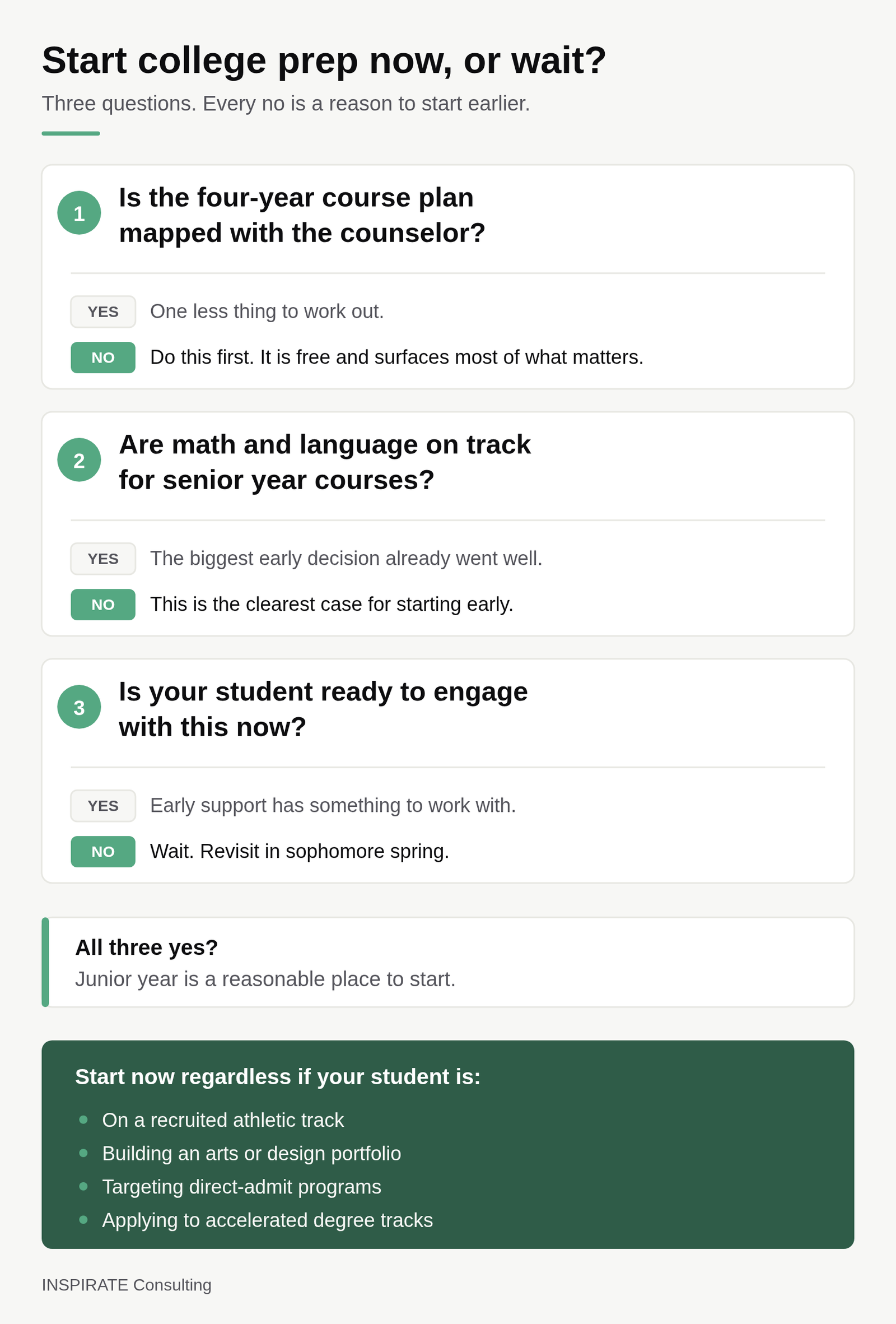
When Starting Junior Year Is the Right Call
For a lot of families, and there’s no reason to feel behind about it.
Start junior year if your student is already in a rigorous course sequence and doing well in it. If the structural decisions went well by default, you’re paying to confirm choices you already made.
Start junior year if your fourteen-year-old isn’t invested. A student who doesn’t want this yet will treat early meetings as one more obligation, and resistance costs more than the delay does.
Start junior year if you want your student to have two more years of being a kid. That’s a legitimate priority, and over-professionalizing a freshman carries real costs that don’t show up in any table.
Start earlier if your student is on a recruited athletic track, building an arts portfolio, or targeting direct-admit or accelerated programs. Those timelines run ahead of the standard one, sometimes by years, and the deadlines are genuinely different.
The Bottom Line
The extra two years buy decisions, not outcomes. If the decisions in front of your ninth grader are consequential and unclear, and course sequencing usually qualifies, early support is worth what it costs. If your student’s path is already set and going well, junior year is a perfectly good place to start.
The one thing worth doing this month regardless: get the four-year course plan on paper and ask the counselor what depends on what. That conversation is free and it surfaces almost everything a family would want to know.
If you’d like a second read on that plan, INSPIRATE offers a consultation where we’ll look at your student’s current course sequence and tell you honestly whether starting now makes sense for your family. Sometimes the answer is that it doesn’t, and you should hear that before you commit to anything.
FAQs
1. When should you start college prep?
There’s no single right answer. Most students do fine starting in the fall of junior year, when essays, testing, and college lists all become live. Starting in 9th grade is most valuable for families making complicated course sequencing decisions, or for students on recruited athletic, arts portfolio, or direct-admit tracks where the timeline runs earlier.
2. Is it too late to start college prep junior year?
No. The majority of the visible application gets built junior and senior year, including every essay, the college list, application strategy, and interview preparation. What’s harder to change by then is the transcript, the depth of the activity record, and which senior year courses are reachable.
3. What should a 9th grader do to prepare for college?
Build a four-year course plan with the school counselor, take the most demanding courses they can handle well, get involved in one or two things they actually care about, start a running document tracking activities and hours, and build a real relationship with at least one teacher. Formal test prep can wait.
4. Does starting college prep early improve admission chances?
Not by itself. Colleges evaluate the application in front of them, and they have no way of knowing when a family started preparing. Starting early helps by keeping options open that otherwise close, which can produce a stronger application. The mechanism is the course rigor and the depth, not the start date.
5. Should a 9th grader take the SAT?
Generally no. A diagnostic in sophomore year is useful for figuring out whether the SAT or ACT is the better fit and where the baseline sits. Official sittings usually make the most sense starting in sophomore spring or junior fall.
6. What’s the most common mistake families make by starting late?
Discovering in junior fall that a senior year course they wanted isn’t reachable because of a sequence decision made in 8th grade. It’s rarely fatal to an application, and it’s almost always avoidable with one conversation three years earlier.